Cotton Farming : Will the ₹5,659 Crore Cotton Mission Boost Productivity or Increase Farmers’ Burden?


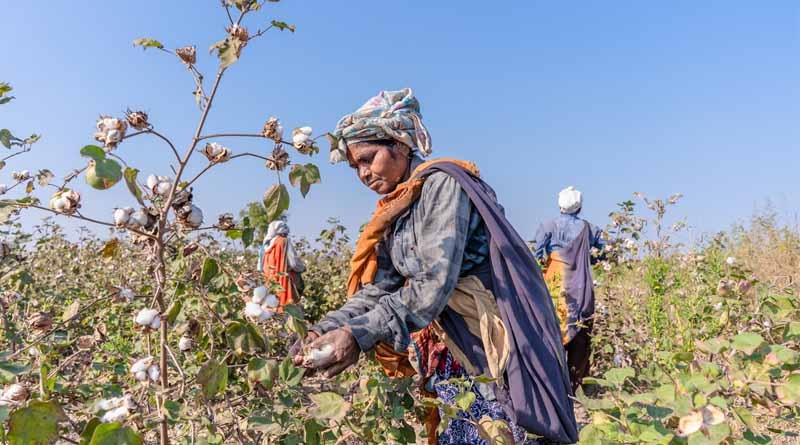
Cotton Farming : The Union government has approved a ₹5,659.22 crore ‘Mission for Cotton Productivity’ under its 5F initiative (Farm, Fibre, Factory, Fashion, Foreign) with the aim of increasing cotton productivity in India by 2031. The Centre looks to utilise the funds to develop High-Yielding Variety (HYV) seeds, upscale technologies such as the High-Density Planting System (HDPS), and modernise ginning factories, in a bid to achieve competitiveness in the global textile industry.
Official sources claim that around 32 lakh farmers will benefit from the Mission for Cotton Productivity, but concerns remain about imposing a further financial burden on cotton farmers.
With 114.47 lakh hectares under cotton cultivation, India accounts for 37 per cent of the world's total cotton cultivation area, making it the largest cotton producer. But in terms of productivity, India ranks 40th, producing 437kg of lint per hectare, while the global average is around 800kg per hectare. The mission is to raise these productivity levels from 440kg/ha to 755kg/ha.
This is planned to be achieved through the development of HYV seeds and improved technologies from Krishi Vigyan Kendras and State Agricultural Universities.
According to NABARD (National Bank for Agriculture and Rural Development), the average Indian farmer has around 1.8 acres of land, and regular cotton farming costs between ₹23,000 and ₹37,000 per acre (depending on the area), making it an already expensive proposition for small farmers.
HYV seeds, a key point in the mission, require more fertiliser, irrigation, and labour, further increasing costs by at least ₹10,000. While the scheme promises to benefit farmers, no direct benefits have been mentioned. Even if the ₹5,659 crore is aid distributed directly to 32 lakh farmers, that comes to around ₹17,000 per farmer over five years, which is largely insufficient for cotton cultivation using HYV seeds.
The commonly cultivated, genetically modified pest-resistant Bt Cotton is already a long-lasting nightmare for cotton farmers in areas like Maharashtra and Karnataka.
Bt Cotton, not ecologically native to India, requires frequent irrigation, while these areas receive infrequent rainfall. Independent analysts link this to the high rate of cotton farmer suicides in areas like this, driven by debt traps stemming from low yields and high interest rates.
On suicide numbers, NCRB data shows that farmer suicides remain high, with a total of 10,546 people, both cultivators and labourers, having committed suicide in 2024.
Maharashtra alone accounted for 37,142 farmer suicides between 2015 and 2024, with areas like Vidharbha, where cotton farming is prevalent, with some reports showing rates 2.5 times the national average.
While Minimum Support Prices (MSP) and credit schemes exist to tackle this, there is criticism that the MSP for cotton does not follow the Swaminathan Commission-recommended C2 + 50 per cent formula.
Experts believe that Against such a backdrop, the Mission for Cotton Productivity risks, farmer debt, income security, irrigation support, and fair MSP implementation, the scheme could end up increasing financial pressure on cotton farmers instead of easing it.