Sansevieria: A oxygen rich plant
Mr. Ronak Mangroliya, Ph.D. (Research Scholar)
Department of floriculture and landscape architecture,
ASPEE College of Horticulture, Navsari Agricultural University, Navsari.
Mr. Parth Mangroliya, M.Sc. (Research Scholar)
Department of floriculture and landscape architecture,
ASPEE College of Horticulture, Navsari Agricultural University, Navsari.
Introduction of House Plant
Plants bring natural beauty to our living spaces. We spent about 90 % of our times indoors. The indoor environment is 5 to 10 times more polluted than the interior. House plant are an ideal way to create attractive and restful settings while enhancing our sense of well-being. House plant: They refer to a group of ornamental foliage and flowering plants, normally grown in containers and used to decorate the house interior, verandah, corridor, porch. Stair, window still etc., in addition, house plants can be satisfying hobby and can help purify the air in our homes.
Importance of House plants:
- Control the indoor humidity
- Easier breathing
- Clean and purify the indoor air
- Reduce stress
- Sharpen focus and creativity
- Reduce noise pollution
- Sets Higher Mood Level
- Soften the look
- Improve the aesthetic
Sansevieria:
 Mother in law tongue, Good luck plant, Lucky plant, Deivil’s tongue, Bowstring hemp
- It belongs to family asparagaceae.
- Growth is Slow, Plants last for many years
- It is classic yet versatile house plant with sword like foliage design
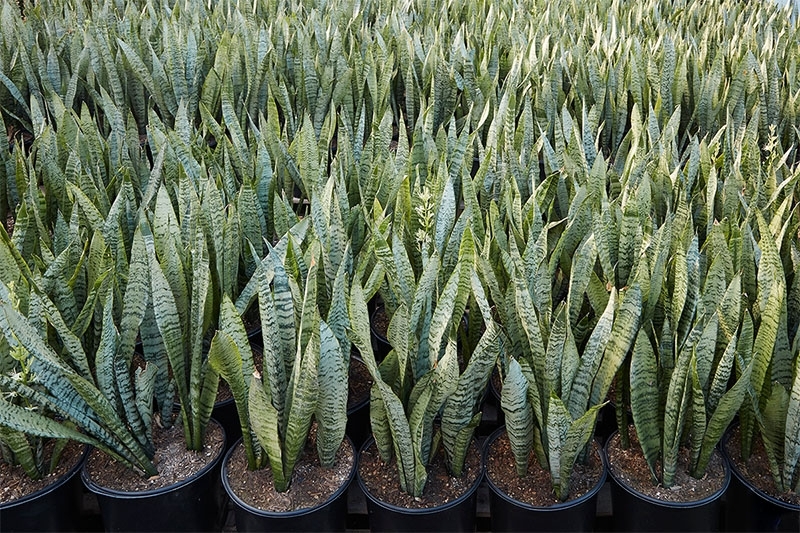
- Sansevieria are characterized by their stiff, upright, sword-like leaves.
- Leaves directly rise from a thick rhizome
Important species of sansevieria:
Species of two main types:
- Tall growing plants with stiff, erect and lance shaped leaves
- Dwarf growing rosette form
| Species Name | Characteristics | |
| S. trifasiata (Mother in law tounge) Erect with long leaves, leathery, linear lanceolate, deep green-white waxy cross band | ||
| S. trifasiata ‘Bantel Sensation’ | Some portion of its tall leaves stripped length wise cream colour, while other portion retain marbling of the species. |  |
| S. trifasiata ‘Craingii’ | Very broad, Cream yellow band running along the margin |  |
| S. trifasiata ‘Laurentii’ | Most popular, Leaves are edged in golden yellow |  |
| S. trifasiata ‘Moonshine’ | Pale green bordered by a fine dark green line, Leaves 9-12 inches long |  |
| S. trifasiata ‘Hanni’ | Squat rosette of leaves, No more than 6 inches tall |  |
| S. trifasiata ‘Golden Hanni | Bold golden yellow margin, Stipes on the green leaves |  |
| S. trifasiata ‘Silver Hanni’ | Silver green leaves, lightly flecked with dark green margin |  |
| S. ehrenbergii ‘Samurai Dwarf’ | Short stature, 4-6’’ tall, leaf V shape and slightly red tint on lead edges and tip and arises on stem in alternative pattern |  |
| S. ehrenbergii ‘Banana’ |  |
|
| S. patens | Cylindrical fleshy leaves that grown in rosette form leaves |  |
| S. metallica | Linear, pointed leaves occurs in rosettes. Leaves are stiff, leathery and 3-4 cm wide. Stripping pattern of grey |  |
| S. liberica | Stiff leaves up to 3 feet long, stripped length wise with wide bands of almost pure white |  |
| S. zeylamica | Grey green leaves, with dark green cross band, arranged in rather loose, spreading rosette |  |
| S. cylindrica | Rigid, circular in outline, grooved, tapering apex, dark green with grey green cross band |  |
Propagation
Snake plant is generally multiplied by rhizomes, leaves and offsets. Leaf cutting is widely used propagating method of sansevierias.

Leaf cutting method
Composition of growing media:
Snake plants do best with a free-draining soil mix because they are easily prone to rot. A soilless potting mixture is best to ensure adequate drainage. Mixture of different media like soil, sand and peat moss in the ration of 1:1:1 is ideal for growing snake plant or 2 parts of coarse sand or perlite and 1-part of peat moss or coconut coir is also used.

Soilless mixture
How to display the plants:
- Group Plant 2. Individual plant

Containers, care and management of house plants:
 The following points are considered while selecting the container:
- Suitability for the plants needs
- Suitability for the needs of the individual and environment
- Cost and availability
- Strength and durability
- Drainage
- Weight
Container:
- Terra cotta
- Burnt clay (used for exterior)
- Plastic or ceramic (indoor)
- Clay pot may be glazed or unglazed Glazed pot restrict air exchange
- Unglazed pot evaporate water faster, than need frequent water
Repotting of sansevieria:
- When the root growth is noticed through the drainage hole (or) when the roots get matted around the outside of the earth-ball (or) when the soil ball of the pot becomes root bound, there is need for repotting.
- Sansevierias do not mind cramped root condition and so can be left undisturbed for several years.
- Fleshy usually, cream –colored roots will often appear on the surface of the potting mixture, but these plants do not need repotting until they crack their pot.
- In upright growing plants repotting is advisable when the leaves occupy most of the pot surface.
- With rosette forming ‘Hahnii’ amd its varieties, if they are packing the pot so that little soil visible repot them immediately.
- In years when plants are not repotted, topdress them with fresh potting mixture.
How to care snake plant:
 Light: Sansevierias like bright sun light and can stand plenty of direct sunlight. They will tolerant certain amount of shade. Plants that have been living in the shade should not move to sunny position without gradual acclimatization. Sudden prolonged exposure to sunlight can result in leaf burn.
- Temperature: As native of tropics, these plants thrive in warmth; 18 oC to 26 oC
- Watering: during active growth period water moderately, giving enough to make the potting mixture moist throughout at each watering, but allowing the top inch of the mixture to dry out before watering again. Overwatering leads to rotting and causes the large leaves of tall growing types to topple over.
- Feeding: Apply standard liquid fertilizer once a month. Standard 20:20:20 formulation is fine for the most indoor plants.
Common issues for your sansevieria:

- Why are the blades on my Sansevieria curling?
Your Sansevieria can go weeks between watering, so overwatering is extremely common. Overwatering and improper drainage will cause leaves to fold but generally not curl. Curling can occur when the plant is underwatered and left dry for too long.
Why is my Sansevieria turning yellow?
 Providing proper soil moisture (or lack of moisture) is important in caring for a Sansevieria. Only water when the top 50% of soil is dry. Water until water flows freely from the drainage hole at the bottom of the pot.
- Pest: Weakened or stressed Sansevierias become more susceptible to insect infestations. Sap-sucking bugs like spider mites can drain your plant of moisture.
- Why are the blades of my Sansevieria leaning?
 Underwatering (dry spells can create stress and cause your plant to have soft)
- Overwatering (If you’re overwatering your snake plant, it can begin to rot at the base of the leaves, causing it to lean and droop to one side.)
- Lack of fertilizer (While water and sunlight give the plant most of its needs, it also requires nutrients like phosphorus, nitrogen, and potassium.)
- Lack of light (Though they tolerate low light, sansevierias thrive in high light, so move it closer to a window and rotate your plant monthly to fix this issue.)
Absorption mechanism in plants
Indoor plants are known to absorb air pollutants via their stomata during normal gas exchange.
- Several pollutants have been shown to be sequestered in situ or after transfer to other locations in the plant.
- The process mechanism involves toxic chemicals absorbed by the plant through stomata and then transferred to the roots where the microbes break down the wide varieties of unhealthy compounds into simpler molecules which could be reabsorbed by plants.
Why indoor air quality is an important for workplace?

- Optimum thermal comfort and good indoor air quality (IAQ) is important for occupants. In tropical region offices, an air conditioner is indispensable due to extreme high temperatures. However, the poor ventilation causes health issues. The desire to save energy and a lack of awareness regarding health and safety issues relating to indoor air quality (IAQ) have resulted in rooms being designed in tropical countries, including Thailand, which allow for all doors and windows to be closed, causing poor ventilation, particularly in hotels. Gases that are generated in closed rooms, which cannot be effectively ventilated can increase to harmful levels, resulting in negative health effects, especially for office workers, who spend most of their working hours inside
building.
Important facts of sansevieria:
- Several NASA studies have shown that snake plants improve indoor air quality and reduce toxins.
- Snake plants can remove up to 87 % of air pollutants at night. These plants can also reduce the amounts of nitrate ions on the air (Scotts, 2021).
- Sansevieria fiber has low costs, a wide availability a high specific strength, renewability and low density and can be used as reinforcement in polymer composites.
- Sansevieria use the crassulacean acid metabolic process, which absorbs carbon dioxide at night, although oxygen released during daylight.
- Suitable bedroom plants.